
Who Gets to Ride: The Quiet Closing of America's Public Stables
Rental stables, pony rides and park riding concessions are disappearing from American cities. The horses are rarely the reason.
On the last day, the wait was four hours. Parents who had ridden the Griffith Park ponies as children stood in line with their own, and near the gate, animal rights advocates and people who wanted the place kept open confronted each other (ABC7). The owner said protesters had been yelling at children and their parents on most weekends that year (Los Angeles Times). Thirty-six horses and ponies were still working, cared for by 17 employees who were about to lose their jobs (Fox 11). It was Dec. 21, 2022. The rides had opened in 1948.
For 74 years, the first horse many Los Angeles children ever touched lived in that ring. In early 2022 the rides were carrying close to 160,000 children a year on about 45 ponies and horses (Spectrum News 1), the largest pony ride operation in the country (L.A. Parent).
The end came after a yearlong fight. The Los Angeles Alliance for Animals accused the concession of overworking its ponies and called for a ban on commercial pony rides across the city (The Columbian). The city hired an independent equine veterinarian, Dr. Rachael Sachar, who visited three times (Sachar report). The city's equine advisory committee read her first report as finding the ponies in generally good health, though the operation needed better veterinary records, water and shade (Los Angeles Equine Advisory Committee). Her last visit found no gross violations of animal care, but it found that four ponies had died that year and six had been moved elsewhere without the city being told for months (City News Service). Citing that lack of transparency, the parks department declined to renew the contract.
The owner, Steve Weeks, said he had told the city: "If you don't like my management, replace me, keep the ponies going" (CBS Los Angeles). The city did neither. Two years later, a survey it paid for found that 70 percent of Angelenos favored offering pony rides to children in the park again. In January 2026, more than three years after the gate closed, the city put the site out to bid, asking for "a vibrant, sustainable, recreational attraction" (Los Angeles Department of Recreation and Parks). Its list of the features residents said mattered most leaves pony rides off.
Griffith Park is the best documented case of something happening across the country with little notice. The places where a family without a horse can put a child on a pony or ride a trail behind a guide are closing, and nobody keeps count. A few are closed by campaigns; more by a permit that never comes, an insurance renewal that doubles, a pasture sold for houses or a liability law that California never wrote. Horses are not leaving America. They are leaving the public, and without that door, riding becomes what its critics already call it: a sport for people with money. This article, the fourth in a series on the pressures facing working horses, looks at why public stables fail, who decides and what a state could do to keep them open.
I have a stake in the argument and should state it. I co-own Ocean View Stables in Daly City, Calif., where we take the public on guided beach rides, teach riding lessons and give pony rides. This is the article in the series about my own trade, so I have tried to give the critics' case its full weight and to put my own numbers on the table.
How Americans learned to ride
For most of the country's history, nobody needed a place to learn. Then the horse left daily life, and riding became something a person had to go and find.
The West answered first. In 1879 three brothers from Pittsburgh, Howard, Willis and Alden Eaton, started a cattle ranch near Medora in Dakota Territory. Friends from the East kept arriving to ride and hunt, and by 1882 the brothers were charging them; historians credit the Eatons with the first dude ranch (WyoHistory.org). The family moved to Wolf, Wyo., in 1904 and still takes guests there. By 1926 there were enough such ranches to form the Dude Ranchers' Association (Dude Ranchers' Association).
Cities answered with the livery stable and the bridle path. The Claremont stable opened on Manhattan's Upper West Side in 1892 and, as the Claremont Riding Academy, sent riders into Central Park until 2007, when it closed as the borough's last public stable (The New York Times). Rock Creek Park in Washington has kept a public horse center for generations, and Golden Gate Park in San Francisco had public stables until 2001.
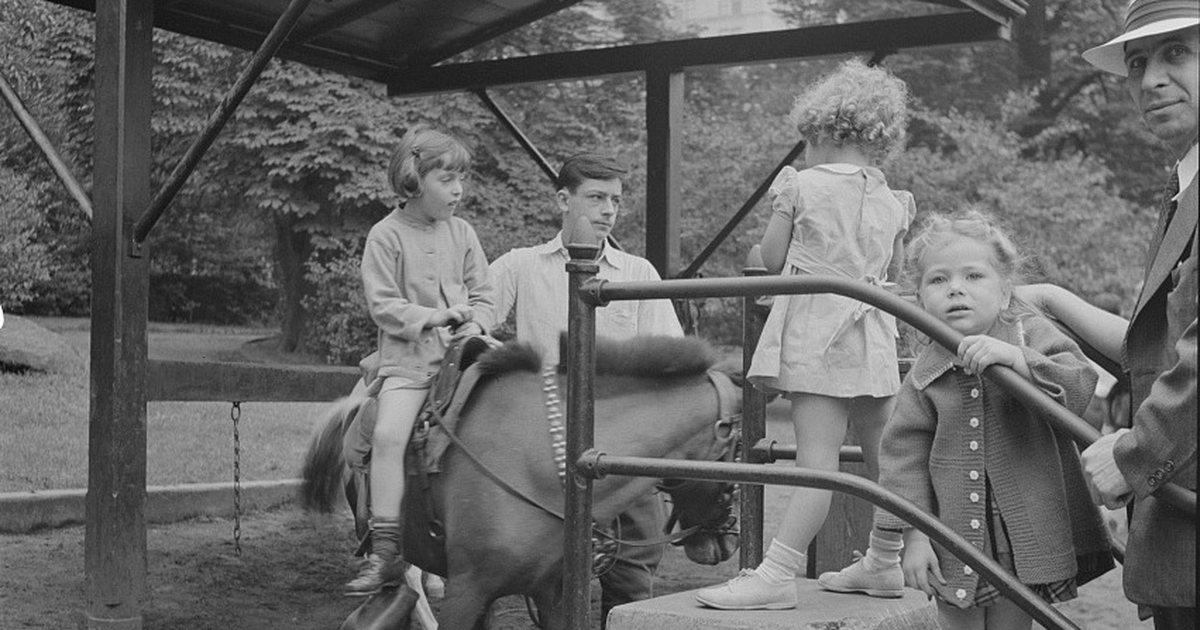
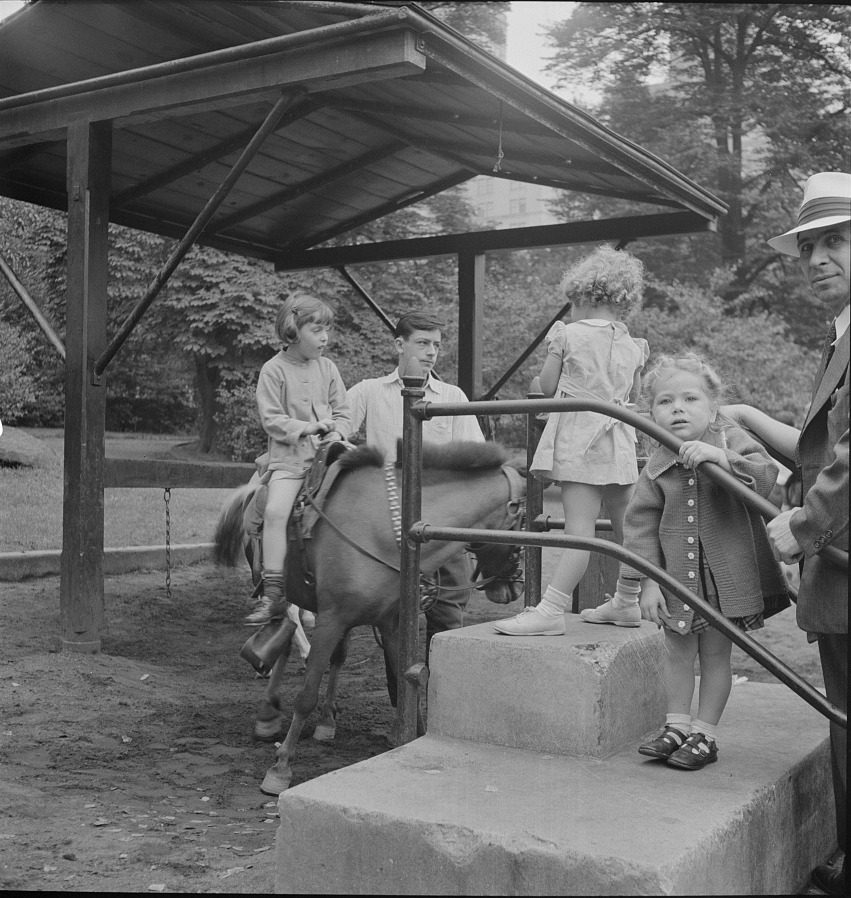
For small children there was the pony ride: a quiet animal, a handler, a few minutes in a ring. A government photographer found children lined up for one in Central Park in 1942. Griffith Park's opened six years later.
None of this was elite. The hunt club and the show barn have always belonged to people with money; the rental string and the pony ring were how everyone else got on a horse. Now the cheap end of the sport is disappearing while the expensive end grows more expensive. Keeping a horse costs $8,000 to $26,000 a year (The Varsity), and a private lesson at a city stable runs $75 to $125 an hour (Lessons.com).
Where the public can no longer ride
No agency counts public riding. An online directory of horse businesses, which surely misses some, lists about 4,260 that offer guided trail rides and 460 that offer pony rides, in a country of 340 million people (Heels Down). The industry counted 9.2 million horses in 2005 and 6.6 million in 2023 (American Horse Council). And the land under them is going: for two decades, equine land groups have cited an Agriculture Department figure of 6,000 acres of farm, forest and open space developed every day (Stable Management).
Here is a partial list of what has closed or changed, and why.
| Place | What happened | Status |
|---|---|---|
| Griffith Park, Los Angeles | Pony rides since 1948. After an activist campaign and a dispute over records, the city declined to renew the concession. | Closed Dec. 21, 2022. Site put out to bid in 2026; the request's list of community priorities leaves pony rides off. |
| Los Angeles, citywide | The Los Angeles Alliance for Animals asked the city to ban commercial pony rides. | Campaign |
| Santa Monica, Calif. | The City Council voted 4 to 0, at about 1:30 a.m. on Sept. 10, 2014, to replace the farmers market pony rides with a non-animal vendor. City animal control had found no violations. | Ended May 2015, after 11 years |
| Paris | After a campaign by Paris Animaux Zoopolis, the city decided to phase out licenses for pony rides in its parks. | Ban from 2025 |
| Golden Gate Park, San Francisco | The city revoked the riding concession's permit in May 2024 after reporting documented overworked horses and an injured rider. | No public riding since that I could find |
| Wunderlich Park, Woodside, Calif. | San Mateo County let the same company's 10-year lease run out and chose a new operator to run the stable and board horses. | New operator since November 2025 |
| Rock Creek Park, Washington | The concessionaire at the capital's only public stable said it was losing money and began moving horses out in February 2025. | Rescued; the Park Service approved a new operator in May 2025 |
| Yosemite Valley | The 2014 Merced River Plan eliminated commercial horseback day rides from the valley. | Ended |
| Manhattan | The Claremont Riding Academy, the borough's last public stable, closed after 115 years. | Closed 2007 |
Only two operators in that table were shown to have done something wrong: the Griffith Park concession, which did not tell the city about deaths for months, and the company that ran Golden Gate Park and Wunderlich. Everywhere else, the horses lost an argument about money, space or taste. The table also leaves out the largest category, the private trail ride barns that close with no headline when the owner retires or the land sells. Nobody keeps that list.
The voices on both sides
The campaign against the Griffith Park rides was specific and well documented. The Los Angeles Alliance for Animals called the concession "animal cruelty disguised as child entertainment" (The Columbian). In Defense of Animals, a national group, pointed to the city veterinarian's own findings of saddle sores, hoof ailments, lameness and dental problems, and said the owner had given her expense reports in place of veterinary records (In Defense of Animals). After the closing, the two groups delivered a letter with more than 11,500 signatures asking the city to put an attraction with no animals on the site (KFI), and the alliance's president, Zohra Fahim, cast the request as a matter of safety for every child who visits the park (KNX).
Paris went further. After a campaign by Paris Animaux Zoopolis, whose argument fit in four words, "Ponies are not toys," a city that had adopted a pony welfare charter in 2021 decided to phase out licenses for pony rides in its parks, starting in 2025 (CBS News).
The rides' defenders had official standing of their own. The city's Equine Advisory Committee told the parks department that it "strongly supports the operation of a pony ride concession" in the park (Los Angeles Equine Advisory Committee). The office of Councilmember Nithya Raman, whose district includes Griffith Park, called the rides "a cornerstone of the neighborhood," even as it said the inspection had found the ponies were not being properly cared for (Council District 4). And in October 2025 the chair of the park's advisory board, Alex Crow, asked the parks commissioners to take the site up again, writing that "the public is owed an update" (Griffith Park Advisory Board).
Read side by side, the record shows more agreement than the shouting at the gate suggested. The city's veterinarian, its advisory committee and the activists all pointed to the same gaps: records, water, shade, oversight. Where they parted was the remedy. One side wanted a better operator. The other wanted no ponies at all.
What Los Angeles said
When the city went looking for what to put on the site, it asked twice. From December 2022 through August 2023 it collected public comments: 432 people wrote in favor of bringing back a pony ride concession, 419 against pony riding of any kind and 22 without a clear view. Then it paid for a statistically valid survey of 564 city residents, taken from Jan. 28 to Feb. 4, 2024 (Los Angeles Department of Recreation and Parks).
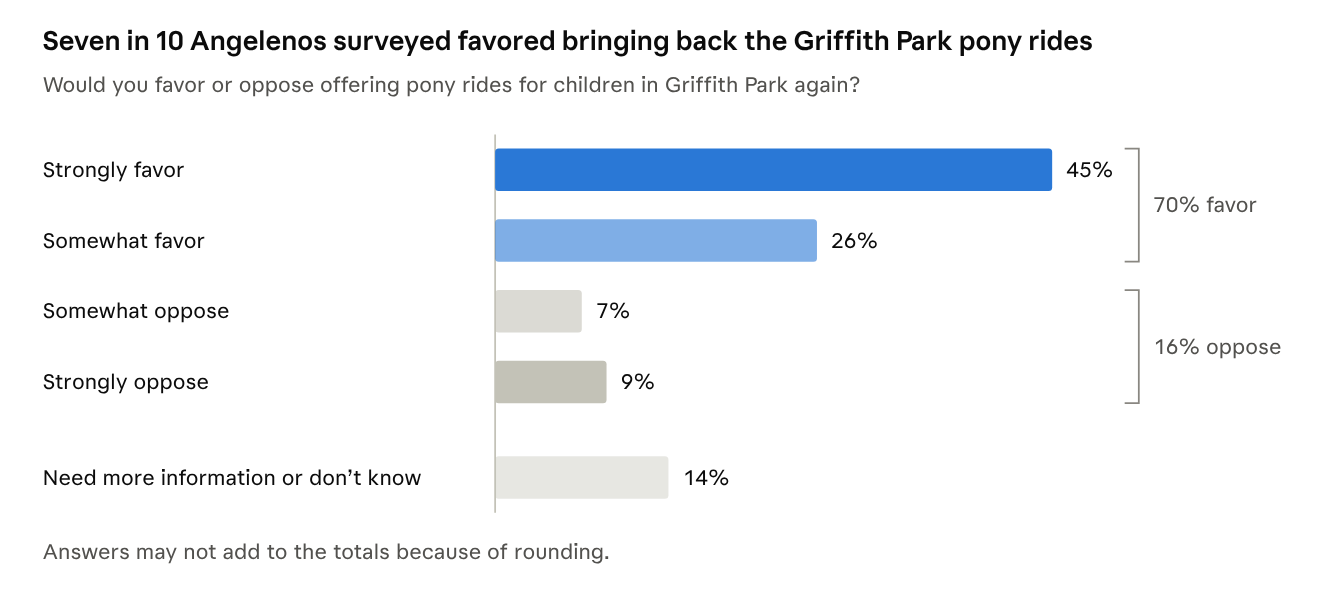
The self-selected comments split almost evenly. The random sample, with a margin of error of 4.4 points, favored the ponies by more than four to one. The same survey asked residents to rate a list of possible uses, and there the ponies had company: 61 percent called a wildlife rescue very appealing, against 51 percent for pony rides, and a community garden, a nature center and an adventure play area also rated a little higher. Angelenos liked several ideas. On the direct question, they wanted the ponies back.
The city did have to choose. Its request for proposals, published in January 2026, asks for a recreational attraction that puts young people first and names four features as the ones residents said mattered most: a live animal experience built around education and rescue, a community garden, a nature center and an adventure play area. Pony rides are not among them, and the request neither invites nor rules them out (Los Angeles Department of Recreation and Parks). Proposals were due May 5. I could find no public announcement of a winner.
Five ways a public stable dies
I went looking for a villain and found a system with nobody in charge. A public riding operation answers to a landlord, an insurer, a permit office, a welfare inspector and a city council, and none of them is responsible for whether the horses are still there next year. Here are the five ways that plays out.
The permit never comes. Every commercial trail ride on national forest land needs a special use permit, and the agency that issues them is buried. Chris French, the Forest Service's deputy chief for the National Forest System, told a House committee that the backlog of expired permits awaiting renewal was "somewhere in the 5,000 to 10,000 range" (Montana Standard). After federal staffing cuts in 2025, outfitters told public radio they faced new uncertainty (KUNR), and some forests post notices that new applications are "deferred until a later date" (Plumas National Forest). An outfitter with a short season cannot wait a year for a signature. If it does not come, he sells the horses, and the trailhead that had a guide has none.
The lawyer says no. Forty-eight states have an equine activity liability statute that shields an operator from suits over the inherent risks of being around horses. California and Maryland do not (Equine Law Blog). So landowners are told by counsel to keep the gate chained. A Florida trail riders' group described the answer riders get even from landowners who ride themselves: "my attorney told me no" (Florida Trail Riders). That sentence closes more riding than any activist.
The insurer walks. Commercial equine liability is a specialty line, and brokers describe the market for horse property and casualty coverage as "very tight," with premiums rising (Insurance Business). A pony ring can absorb one steep renewal, not three in a row, and it cannot open for a day without the policy. When it closes, the city sees an operator who quit. The operator saw a renewal letter.
The land is worth more as houses. The Las Colinas Equestrian Center in Irving, Texas, ran for more than 30 years before it closed in 2015; within a year its 18 acres were sold for 70 single-family lots (Dallas Morning News). In Philadelphia, the Fletcher Street riders lost their original stables and then their grazing lot to public housing (Billy Penn). The 6,000 acres a day are the pasture behind the barn.
The city decides the horses are a problem, not a service. This is the Griffith Park failure, and the one a city controls. Los Angeles ran the inspection, got the findings and had a repair list. It could have put the concession out to bid the next month with the repairs written into the contract. Instead it began a process of comment summaries, a consultant's study, a survey and a historic structures report, and more than three years later it issued a request whose list of community priorities leaves pony rides off. Nobody at the city was assigned to keep the ponies.
That is the common thread: the Forest Service answers for the forest, the insurer for its shareholders and the council for the budget, but no one answers for whether a child can still get on a horse in 10 years. Where nobody is responsible, the default is closure, because closure requires no one to act.
One company, three counties, no shared file
Golden Gate Park shows how long it takes to bring public riding back and how fast it can go. The park's last public stable closed in 2001. After a two-month pilot in 2017 with 15 horses (SF Station), a company called Chaparral opened a concession in November 2019 with trail rides, lessons, pony rides and camps, promising free visits for public schools and underserved communities (Richmond Review/Sunset Beacon). Phil Ginsburg, general manager of the city's parks department, said the department was "thrilled to have them back" (KTVU).
In May 2024, The San Francisco Standard reported on employees who said horses were overworked and underfed, a horse that collapsed, a beginner who left a lesson with a broken back and pelvis, and complaints to the city going back years (The San Francisco Standard). Within days, the department revoked the company's permit for Golden Gate Park and for Camp Mather, the city's family camp near Yosemite (Richmond Review/Sunset Beacon). Two months later, one of the company's horses died in the heat at another site, and Santa Clara County opened a neglect investigation (The San Francisco Standard). The city said it would look for a new operator. I could find no sign that one has started.
Down the Peninsula, Chaparral had run the county stable at Wunderlich Park in Woodside since 2015, where the county's website advertised trail rides, lessons, camps and pony rides (San Mateo County Parks). Records obtained by The Almanac showed people asking the county to remove the company since 2022, including an email to the parks director with 2021 photographs of overworked horses with head injuries, overdue hoof care and untreated saddle sores. Animal control made unannounced visits and never reported a violation. The county's parks spokeswoman, Carla Schoof, said findings at other locations did not bear on Wunderlich: "We couldn't use something that's occurred elsewhere to be a decision maker" (The Almanac).
She was describing the rules as they stand: each county writes its own lease, inspects its own stable and keeps its own file. When the 10-year lease ran out in 2025, the county sought proposals to run the stable and board horses, and Chaparral applied to keep it. In October the Board of Supervisors gave a two-year probationary contract to Excel Equestrian, a Redwood City company that already worked out of the stable (The Almanac). By then Chaparral had closed operations across the region, and a manager at its Los Gatos stable had been charged with animal cruelty after a horse died of malnutrition and neglect.
The public came out of it unevenly. San Francisco lost riding in its largest park; in San Mateo County, the coverage of the new contract describes boarding and stable care without saying whether public rides continue. And nobody in the three counties had one place to look up what the company had done in the others. A state license would change that. Under the commission proposed in this series, an operator holds one license, and every finding against it, in any county, goes into one public file that any landlord can read before renewing a lease. A good operator would carry its clean record from park to park.
The strongest case against public riding, and its limits
The case for closing these places deserves its full strength, because parts of it are right. Golden Gate Park should bother anyone in my business: the complaints sat for years, and it took a newspaper, not an inspection, to bring them out. At Griffith Park, an honest operator should read the veterinarian's list and wince. Saddle sores, hooves, teeth, missing records and deaths reported months late were all fixable, and all were failures of oversight before they were anything else.
Critics are right, too, that riding is more dangerous than most people assume. A 2021 study of nearly 25,000 adults treated at American trauma centers found that, hour for hour, riding sends more people to the hospital than football, motorcycle racing or skiing (BMJ). One estimate puts it at 0.49 injuries per 1,000 hours on a horse, against 0.14 on a motorcycle (ScienceAlert). A horse is a thousand-pound animal with opinions of its own, and anyone who rents one out and says otherwise should not be in the trade.
The deepest objection is not about injuries at all. A horse never agrees to carry anyone. A pony walking the same circle for hours has a dull life, whatever its body condition. Children can learn respect for animals at a sanctuary, where nothing is asked of the animal in return. And some will object to the liability law I propose below, because a statute that protects a stable shifts the cost of an injury to the person who was hurt.
We do not hold other dangerous pastimes to the closing standard. The U.S. Parachute Association counted 16 deaths in 2025 across roughly 3.47 million jumps (U.S. Parachute Association); the Coast Guard counted 556 deaths in recreational boating in 2024 (U.S. Coast Guard); and American Whitewater receives reports of 30 to 40 deaths on moving water in a typical year (American Whitewater). Each answered its deaths with training, equipment standards, inspection and a public count, and none was outlawed. A skydiver chooses the risk and a horse does not, which is the best reason to measure the horse's welfare independently and in public. It is not a reason to stop.
The trauma figures also describe all riding: ranch work, jumping, young horses, riders alone with no helmet. A pony led at a walk and a seasoned string horse behind a guide are the gentlest forms the activity takes, and the only ones a city can inspect. Close the public stable and people who want to ride do not stop; they ride a friend's horse in a field, with nobody watching. A park concession is the one horse business a city fully controls: it writes the contract, sets the workload and sends the veterinarian. Los Angeles did exactly that, and the inspections found real problems and a way to fix them. Then the city used the findings to end the rides instead of to repair them.
My own numbers
It is easy to say an operator should count. Here is what counting looks like at my stable.
Our booking system shows that between May 1, 2025, and Nov. 18, 2026, Ocean View Stables put about 8,800 riders on horses: roughly 5,100 on guided beach rides, 3,400 in lessons and 270 on pony rides. In that time we recorded five incidents involving a rider on a guided ride, at least three of them falls, and one in which a visitor who was not riding was kicked. That is about one reported incident for every 1,000 beach riders. We recorded none in lessons. No one died. Our insurer has not paid a claim on any of them, and none has become a lawsuit.
I do not offer those figures as proof that riding is safe. I offer them to show that the numbers exist and that an operator can produce them in a morning. Every incident on that list changed something about how we work. No agency has ever asked to see it.
That is the gap behind every California failure in this article. San Francisco learned what was happening in its stables from a reporter. Los Angeles learned of four pony deaths months late. San Mateo County had complaints and a neighbor's findings but no rule that let it weigh them. The information existed each time. Nobody was required to send it anywhere, and nobody was assigned to read it.
What a commission would build
The second article in this series set out how a state Large Animal Welfare Commission would police the trade: a license that can be suspended, incidents filed within 48 hours, audits, necropsies and published rates, with nine members, no sector in the majority and costs carried by license fees and fines. That half answers the critics. If the commission stops there, it is one more office that can say no, and this article has shown what happens when every office can say no and none can say yes. The other half of its job is to say yes, the way a parks department builds pools as well as writing the rules for them. It would have five jobs.
Keep the land list. Every county has ground that could hold a string: fairgrounds empty most of the year, park stables with no concessionaire, surplus farmland, and the barns at Golden Gate Fields, which closed to racing in 2024 and which the next article in this series takes up. The commission would keep that inventory and match it to licensed operators, the way an economic development office matches employers to empty buildings.
Write the request, and fill it. When a park concession goes dark, the commission would draft the request for a new operator within 30 days, with the welfare terms built in: a license, a workload limit, a veterinarian on a schedule, incidents reported to the state. It would recruit bidders and score them on their records in the state register. Los Angeles took more than three years to put Griffith Park out to bid; San Francisco has gone two and a half years without a riding concession.
Walk the permit. Each licensed operator would get one case officer for the city, county, state and federal approvals a stable needs, with standing to ask why a file has stalled. State permits for riding on public land would come with a 90-day clock, and the state would lend its weight to an operator waiting on a federal one.
Carry the bills. The first is the one 48 states already have: an equine activity statute that protects an operator from suits over the inherent risks of being around a horse, never over negligence. California's should cover only licensed operators who meet the standard and report their numbers, which gives every operator a reason to want the license and insurers a reason to write the line. The second would fix a gap in the state's recreational use law, which protects a landowner who lets the public ride across his property for free, but not one who is paid (California Civil Code section 846); a rancher who leases pasture to a licensed operator should keep that protection. The third is a line for public riding in state park grants.
Keep score. Each year the commission would report how many licensed operators there are, how many opened and closed and why, how many people rode and how many were hurt per 1,000 rides. It is the number this article could not find anywhere, and the number a state needs before it can say whether it is winning or losing.
The fair objection is that a body that promotes a trade will go easy on it, the same worry the second article raised about Ohio's livestock board. The answer is structural: the two halves sit in separate offices, the welfare side's findings are public before any site is awarded, no operator under suspension can bid, and the development side is judged on riders served safely, not on how many operators it keeps in business.
One body with both halves would also change the politics. Today the welfare advocate and the stable owner meet in front of a council about to close something. Put them on one commission, with one license and one public register, and each gets what it has been asking for: the advocate, an inspected horse and a record anyone can read; the operator, someone in government whose job is to keep the stable open.
A horse with a job, and a child on a pony
A good string horse has one of the better lives a horse can have. He is chosen for a quiet mind and works at a walk, a few hours a day, in a herd he knows. He is fed, shod and seen by a veterinarian because he earns his keep, and a horse that earns his keep is one someone can afford to keep for 20 years. Take the job away and that arithmetic stops. Nobody keeps 45 ponies in a city park for their own sake.
The horsemanship that makes such a horse is the patient kind. You cannot bully a pony into standing still for a 3-year-old. It takes consistent handling, clear signals, a release the moment the horse does the right thing, and an animal that trusts the people around it. Done well, the horse is calm because he understands his job, and anyone who has watched one lower his head for a small child knows the difference between a calm horse and a shut-down one. An inspector can learn to tell the difference too.
Then there is the child. Researchers at Washington State University ran a randomized study of 130 students in grades five through eight and found that those who spent 12 weeks learning to handle and ride horses had significantly lower levels of the stress hormone cortisol than those on the waiting list (Washington State University). That was a structured program, not a five-minute pony ride. But the lap is where it starts, and for most children in a city it is a public pony ring or nothing.
That is who loses when these places close. The family with a show barn is untouched. The people locked out are the ones who were never going to own a horse: the families in the Griffith Park line, the visitor who books one beach ride in a lifetime, the North Philadelphia children at Fletcher Street who muck a stall after homework and ride for free. Ellis Ferrell, who founded that club, built it so that children with no money could ride as he had (Billy Penn). The city took his first stables for one housing project and his grazing lot for another. Nobody voted against horses. The land was simply worth more without them.
Fix the operator, keep the ride
When a pony ring or a rental string fails, a city has two choices: replace the operator or remove the horses. Nearly every city in this article chose the second. Here is what the first looks like.
- License the operator and the lead guide. A state license that can be suspended, and a guide who can show he reads a horse and handles an emergency.
- Put every horse on the record. Identification, age, veterinary and farrier visits, hours worked and days off, in a form the city can audit, with a death or retirement reported within days.
- Handle the string the patient way. Consistent signals and a release of pressure, never a horse worked through pain or fear, and inspectors who watch the handling as well as the horses' bodies.
- Set the workload in the contract. Hours, rest days, heat limits and rider weight limits, written before the first ride.
- Match the horse to the rider. An honest riding assessment, a helmet on every child, a guide ratio and the right to say no.
- Report the numbers. Riders carried and every incident, filed with the commission and published. Mine are above.
- Send the veterinarian on a schedule, not in a crisis. From the first day of every public concession, with the reports posted.
- When an operator fails, replace the operator. A request for a successor within 30 days, so the public is not punished for the operator's failure.
- Pass the liability law, for licensed operators only. Protection from suits over the inherent risks of riding, never for negligence.
- Plan retirement for the string. A written placement plan for every horse and pony, funded by a small fee on each ride.
- Keep the price within reach. Affordability written into the contract, and children served counted as a public benefit, the way cities count swimmers at a public pool.
The empty ring
What sits on the Griffith Park site today is paperwork: a request for proposals, a historic structures report and a consultant's list of ideas. The survey found seven in 10 Angelenos wanted the ponies back; the request left them off its list of what the community wanted most. Proposals were due in May. Whether any would put a child back on a pony, the city has not said, and nobody at City Hall was ever assigned to make sure one does.
The four-hour line on the last day was the public's answer to the question the city has spent years asking. The choice in front of Los Angeles, and every city with an empty ring, is not between horses and animal welfare. It is between a country where a child can still get on a horse for the price of a movie ticket and one where riding belongs to the people who already own one.
Fix the operator. Count everything. Make someone responsible. Keep the ride.
How this article was reported
This article draws on public records from the City of Los Angeles, including the veterinarian's reports, the city's letters, its consultant's survey and comment appendices, its advisory bodies' letters and the 2026 request for proposals; on San Mateo County records as reported by The Almanac; and on the news reports, statutes and published studies listed below. Quotations come from public statements, letters, documents and news reports. I did not interview the people quoted. Where sources disagreed, as early news accounts of the Griffith Park survey did, I relied on the primary document. Ocean View Stables' figures come from the stable's own booking system and incident records.
Image credits
- Children at the pony rides in Central Park, New York, 1942. Marjory Collins, U.S. Office of War Information. Library of Congress, LC-DIG-fsa-8d22249. Film border trimmed.
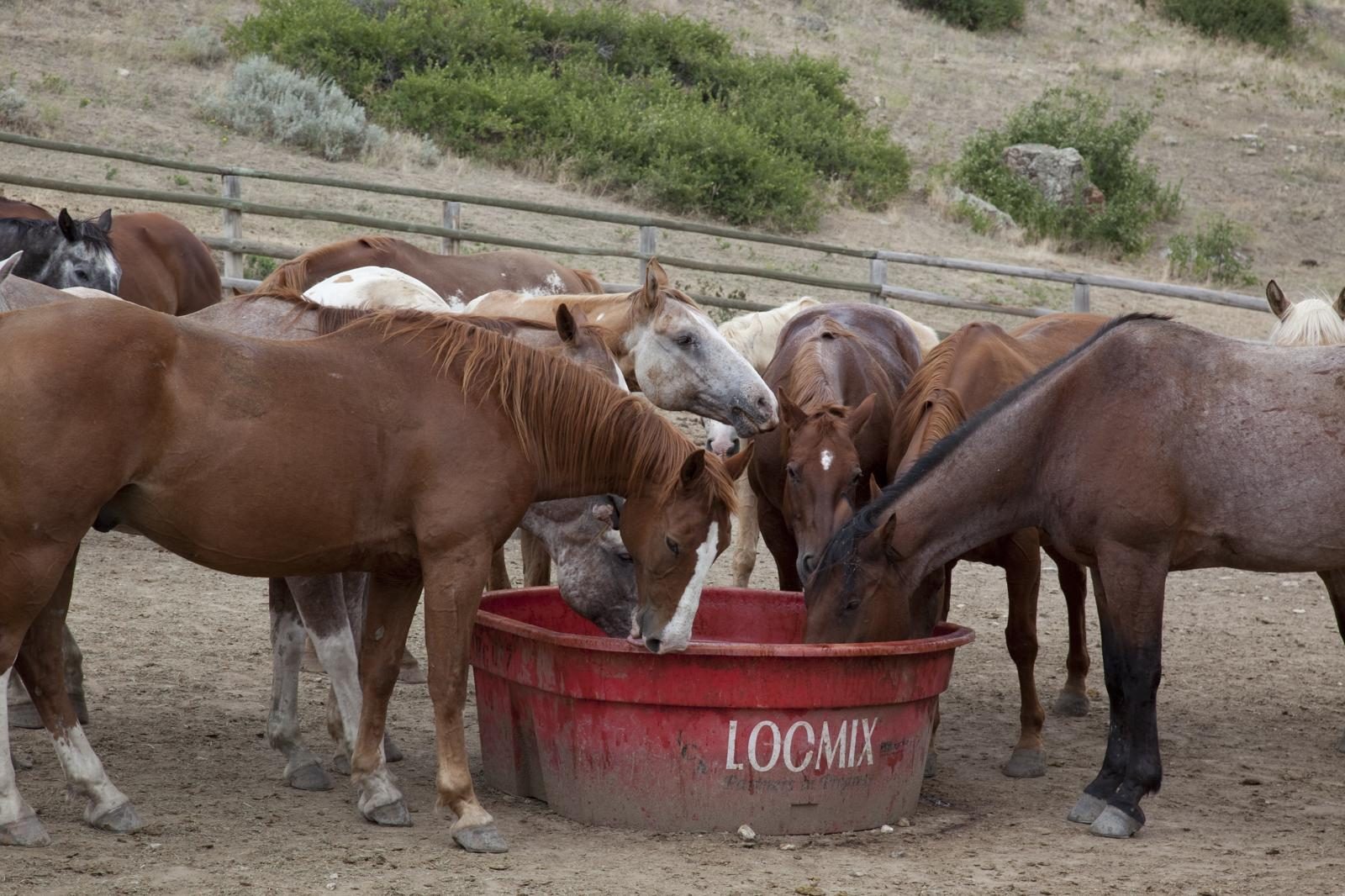
- Horses at Eatons' Ranch, Wyoming, 2009. Carol M. Highsmith. Library of Congress, LC-DIG-highsm-04655.
The Library of Congress lists both with no known restrictions on publication.
Sources
Griffith Park
- Los Angeles Department of Recreation and Parks, 2026 request for proposals, and the city consultant's survey and comment appendices, on the site's future.
- Dr. Rachael Sachar's report, January 2022, the city's letter to the operator, Jan. 26, 2022 and the Los Angeles Equine Advisory Committee's letter, on the inspections.
- City News Service via HeySoCal, Dec. 7, 2022, on the four deaths and the city's reasons.
- ABC7, Dec. 22, 2022, Fox 11, CBS Los Angeles and the Los Angeles Times via AOL, on the last days.
- Spectrum News 1, Jan. 14, 2022 and L.A. Parent, on attendance.
- The Columbian, Dec. 17, 2021, In Defense of Animals, KFI, Nov. 2, 2023 and KNX, on the campaign.
- Council District 4 and the Griffith Park Advisory Board, Oct. 28, 2025.
The Bay Area
- SF Station, April 2017, Richmond Review/Sunset Beacon, Oct. 30, 2019 and KTVU, Nov. 3, 2019, on riding's return to Golden Gate Park.
- The San Francisco Standard, May 17, 2024 and July 26, 2024, and Richmond Review/Sunset Beacon, June 7, 2024, on the revocation.
- The Almanac, Aug. 20, 2025 and Oct. 14, 2025, and San Mateo County Parks, on Wunderlich Park.
Other closures
- Santa Monica Daily Press, on Santa Monica; CBS News, on Paris.
- NBC Washington, Feb. 7, 2025 and The Washington Post, May 15, 2025, on Rock Creek Park.
- National Park Service, Feb. 14, 2014, on Yosemite Valley; The New York Times, April 30, 2007, on Claremont.
- Dallas Morning News, March 23, 2016, on Las Colinas; Billy Penn, Nov. 29, 2020, on Fletcher Street.
Risk, law and benefit
- BMJ news release on the 2021 trauma center study and ScienceAlert, on injuries.
- U.S. Parachute Association, U.S. Coast Guard and American Whitewater, on other risks.
- Equine Law Blog, California Civil Code section 846 and Florida Trail Riders, on liability.
- Montana Standard, KUNR, May 2, 2025 and Plumas National Forest, on permits; Insurance Business, on insurance.
- Washington State University, on the cortisol study.
Numbers and history
- Heels Down directory, American Horse Council and Stable Management, on counts and land; The Varsity and Lessons.com, on costs.
- WyoHistory.org and the Dude Ranchers' Association, on dude ranching.
Ocean View Stables figures are from the stable's own booking system and incident records.
