

Opinion: The Star Act Has 80 Senate Cosponsors. Four Senators Have Kept It Off the Floor.
Opinion by Zachary Leyden, a veteran. The views here are his own. The facts come from the public record: three House roll calls, the Congressional Record and the Congressional Budget Office. For a report on both House bills that takes no side, see our news coverage.
The House passed the Major Richard Star Act 392-18 on Thursday, November 12, 2026. In the Senate, the same bill has about 80 cosponsors and has never received a vote.
The record explains both facts. It shows what the current rule costs a combat-injured veteran: about $1,450 a month on average, by the Congressional Budget Office's count. It shows that four senators, one at a time, have stopped the Senate from voting. And it shows how a dispute over the bill's wording produced a $78 billion price tag for a fix the budget office now scores at about $13 billion.
My view is simple. Military retirement pay and VA disability compensation are two different debts, and the Senate should vote to pay both. Here is the record behind that view.
What the offset takes
A service member injured badly enough to be found unfit for duty is medically retired, often years short of the 20 needed for a regular pension. The Pentagon pays disability retirement. The VA pays disability compensation. Federal law then subtracts the VA payment from the retirement check, dollar for dollar.
Congress later added a partial repayment for combat-related injuries, called Combat-Related Special Compensation. But for anyone retired with under 20 years, the law caps it at the pension their years of service alone would have earned. In its cost estimate dated Tuesday, October 27, 2026, the budget office said the cap significantly limits payments to veterans with severe combat injuries after short service. The earlier in a career the injury came, the less comes back.
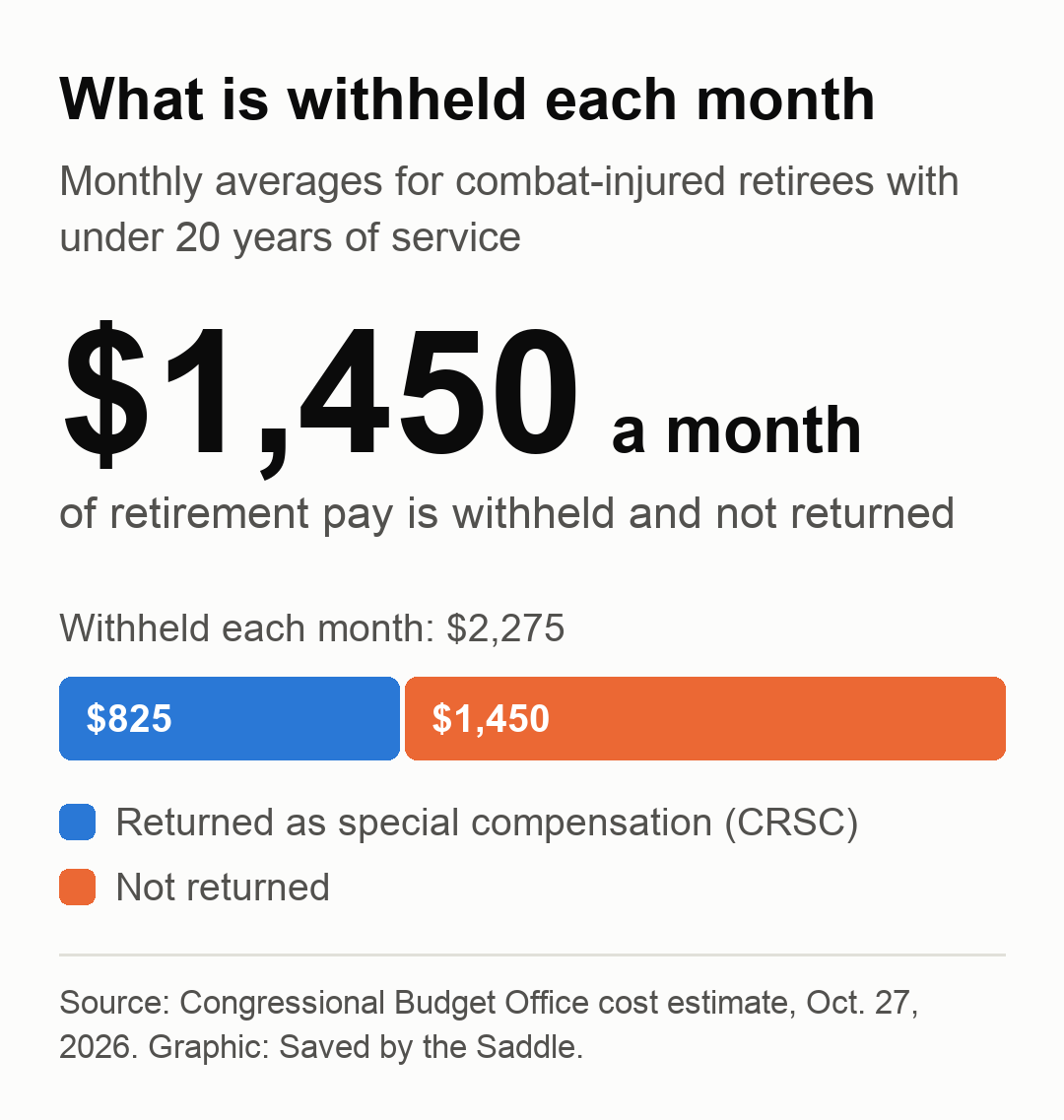
The budget office put numbers on it. About 58,000 medically retired veterans with under 20 years of service were receiving the special compensation in September 2025. Their retirement pay was reduced by an average of about $2,275 a month. The special compensation returned about $825. The Star Act would pay them about $1,450 more each month, before inflation adjustments.
Veterans who complete 20 years do not face this. Since 2004, Congress has phased out the offset for retirees with 20 years of service and a VA rating of 50% or higher, according to the Congressional Research Service. The rule that remains falls on those whose careers ended early because they were hurt in combat.
The bill is named for Maj. Richard Star, an Army Reserve officer who spent his final years asking Congress to fix this while fighting cancer. He died on Saturday, February 13, 2021, at age 51.
The case against, stated fairly
The strongest objection is not about money. It is the idea that these veterans would be paid twice for one injury. The Congressional Research Service calls this the double-dipping concern: Congress has generally barred two lifelong federal payments for the same event. Senator Roger Wicker of Mississippi made that argument on the Senate floor on Wednesday, October 8, 2025, saying the bill would compensate the same disability twice, according to the Congressional Record.
Opponents add a real distinction. A 20-year pension is earned by time served, while a medical retirement is itself a payment for disability.
I do not accept the conclusion, for two reasons. First, the payments answer different questions. Disability retirement from the Pentagon stands in for the military career that the injury ended. VA compensation covers what the injury costs for the rest of a life. A civilian who draws a pension and wins a workplace injury settlement keeps both. Second, these veterans did not choose to leave short of 20 years. The injury made that choice, and the current rule turns it into a pay cut.
The Pentagon's leadership is on record. Defense Secretary Pete Hegseth said "we support the Richard Star Act" at a Senate Armed Services Committee hearing in April 2026, according to a release from the Senate Veterans' Affairs Committee's Democratic staff.
One bill, three price tags
Cost is the reason every objector has given. So the number matters, and for most of this year the number was in dispute.
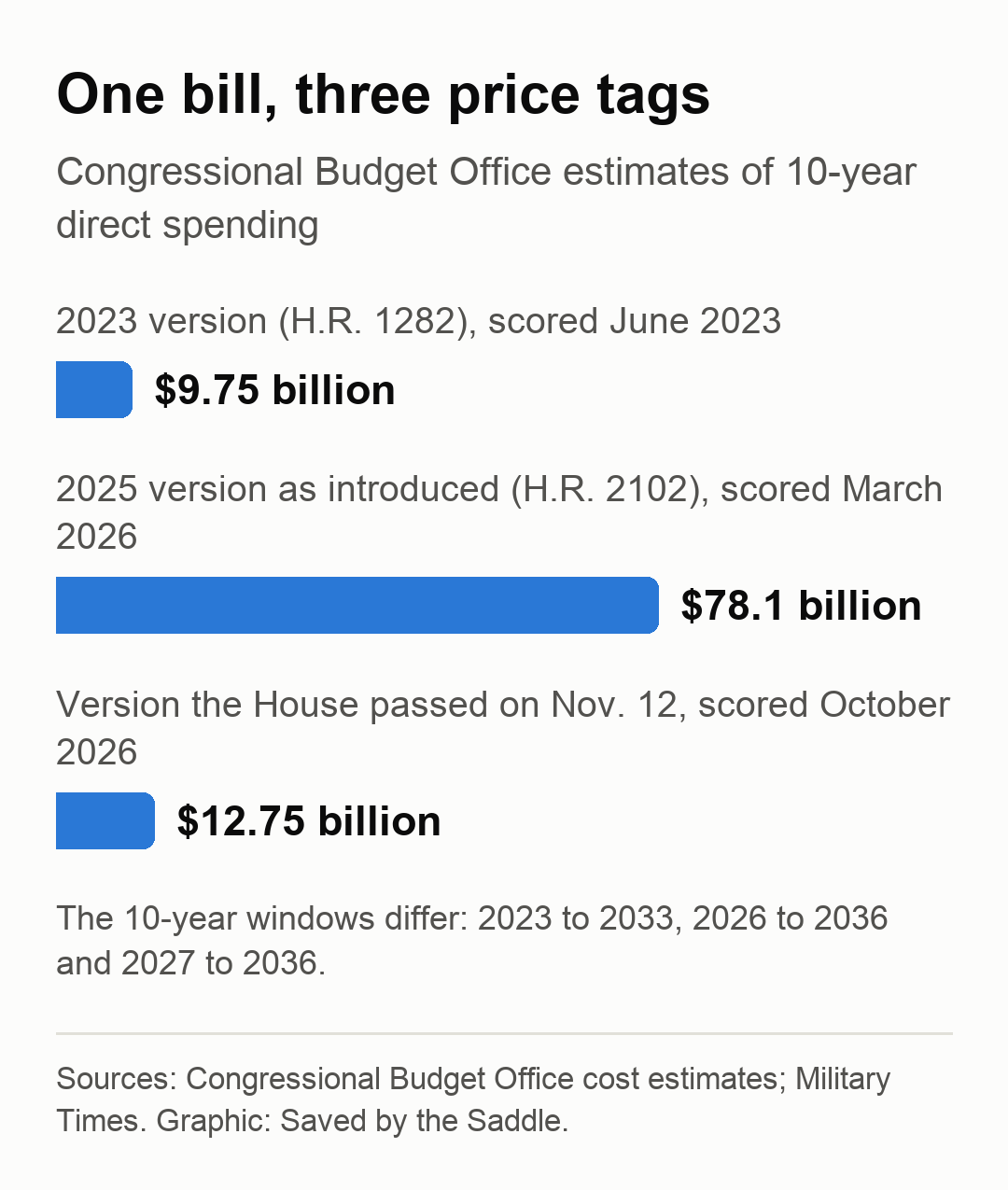
In June 2023 the budget office scored that year's version of the bill at $9.75 billion over ten years. On Monday, March 23, 2026, it scored the current bill, H.R. 2102, at $78.1 billion. Military Times traced the jump on Wednesday, July 22, 2026. The budget office read new wording as opening full concurrent pay to about 255,000 medical retirees, not only the combat-injured. Staff in Senator Richard Blumenthal's office told the paper the wording was meant to reach about 1,124 combat-injured retirees left out of earlier versions. The budget office stood by its reading.
The House settled the question by changing the text. The resolution that brought the bill to the floor, H. Res. 1247, narrowed it to combat-injured retirees with under 20 years of service. The budget office scored that version at $12.75 billion in direct spending from 2027 through 2036.
Supporters should state the full cost plainly. Beyond the $12.75 billion, the budget office expects the Pentagon's payments into the military retirement fund to rise, which it counts as $7.45 billion in spending subject to appropriation over the same period. It also projects that the bill would add more than $5 billion to deficits in each of the four decades after 2036.
Now the scale. Direct spending of $12.75 billion over ten years is about $1.3 billion a year. The Senate's defense bill for fiscal 2027 supports $1.15 trillion for national defense. The fix comes to about one tenth of one percent of that.
Three House votes in two days
House leaders did not schedule this vote. A discharge petition signed by 218 members forced it. The roll calls show what happened next.
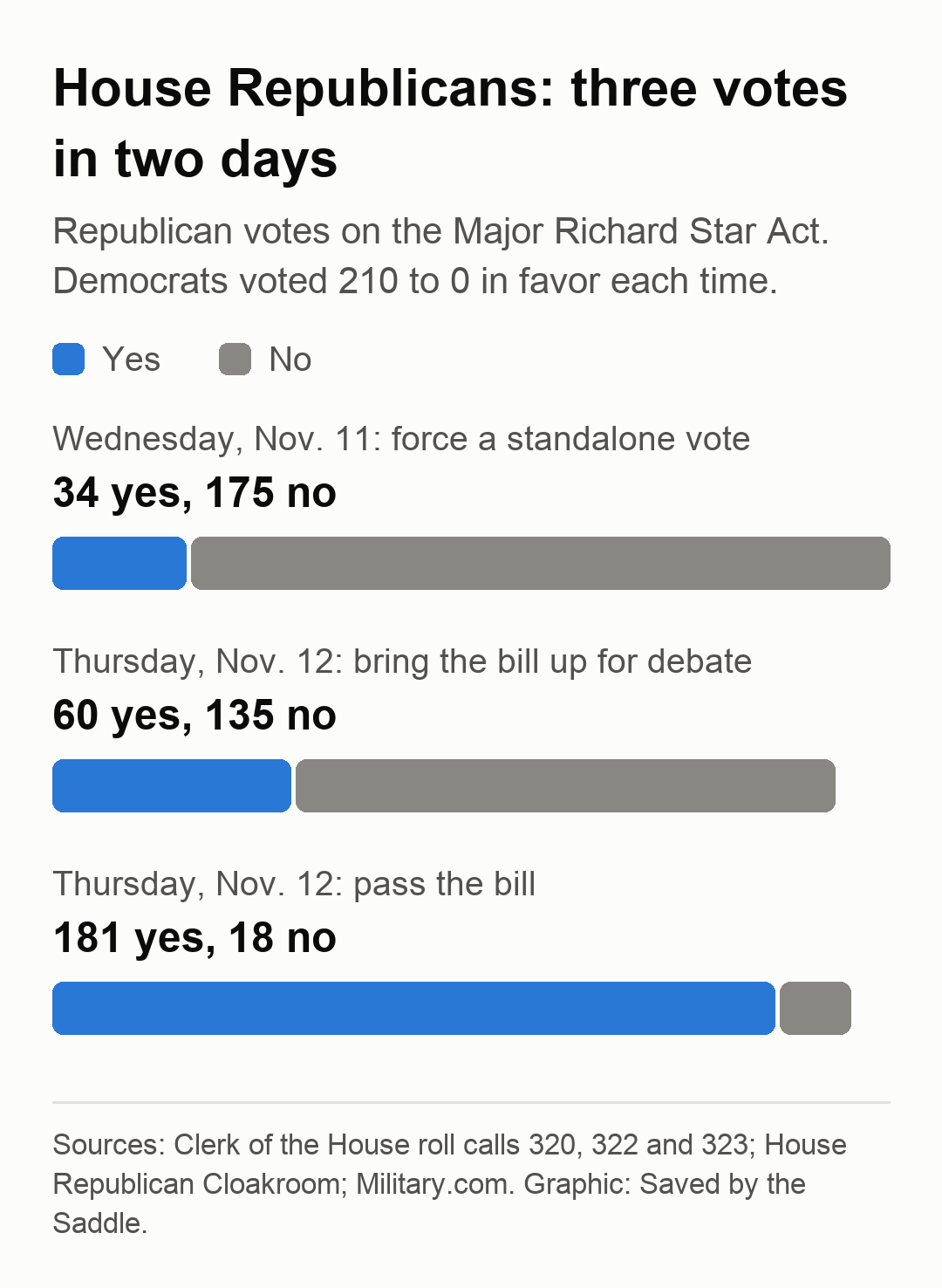
On Wednesday, November 11, 2026, Republicans voted 175 to 34 against forcing a standalone vote. Speaker Mike Johnson, Majority Leader Steve Scalise and Veterans' Affairs Committee Chairman Mike Bost were among the 175, Military.com reported. The next morning Republicans voted 135 to 60 against the rule to debate the bill, the House Republican Cloakroom's floor summary shows. Then, on final passage, they voted 181 to 18 in favor. Johnson, Scalise and Bost voted yes.
Every Democrat who voted backed the bill all three times, 210 to 0.
The pattern says the fight in the House was over the route, not the destination. Leaders wanted the fix to travel inside a larger package, the Take Care of America's Veterans Act, which pays for it by changing how sleep apnea and tinnitus are rated for future claims. Once members had to vote on the Star Act by itself, with their names recorded, nine in ten Republicans who voted said yes.
Four senators, eight objections
The Senate has no discharge petition. A bill reaches the floor when leaders schedule it or when no senator objects. Senator Blumenthal, the senior Democrat on the Veterans' Affairs Committee, has gone to the floor on four days and made eight requests, by his office's count. In October, in March and on June 9, his fallback request was only for a single roll call vote, with 60 votes required to pass. One senator objected every time.
- Wednesday, October 8, 2025: Roger Wicker, R-Miss.
Cost of about $9 billion to $10 billion, no offsetting savings, and double compensation (Congressional Record). - Tuesday, March 3, 2026: Ron Johnson, R-Wis.
Cost, citing the national debt and the growth in veterans benefits (Stars and Stripes). - Tuesday, June 9, 2026: Rand Paul, R-Ky.
No funding source. "We should offset it," he said (Stars and Stripes). - Wednesday, June 17, 2026: Thom Tillis, R-N.C.
No agreed way to pay; said the bill should be worked out in committee (committee release).
Read that fallback request again. The objectors were not only declining to pass a bill without a vote. They declined to let the Senate vote at all, at a 60-vote threshold the bill's cosponsors could clear by themselves.
On June 17 Blumenthal answered the cost objection directly. He proposed paying for the bill with $13 billion from unspent funds in the 2025 budget law, H.R. 1, according to the committee release. Senator Tillis objected, saying the bill was not ready and belonged in committee.
No senator has ever cast a recorded vote on the Star Act. The House-passed bill was received in the Senate on Thursday, November 12, 2026, and referred to the Armed Services Committee, Congress.gov shows. That committee's chairman is Senator Wicker, the first of the four objectors.
The fight over who pays
There are now two ways to pay on the table. The House package would fund the fix through the sleep apnea and tinnitus changes. A VA analysis found those changes could affect as many as 1.5 million veterans and reduce payments by up to $57 billion over ten years, as our news report describes. The Veterans of Foreign Wars and Disabled American Veterans oppose that. The American Legion and other groups back the package as the practical route. Blumenthal's alternative draws on unspent funds from the 2025 budget law.
Congress can argue about the source. It should not use that argument as a reason to pay nothing.
What the Senate should do now
The votes exist. About 80 senators have put their names on S. 1032, and 60 are enough. What is missing is floor time, and the willingness of a few senators to lose a vote instead of preventing one.
The clock matters. Any bill not passed by both chambers when this Congress adjourns in January 2027 dies, and six years of work starts over.
The ask is simple: hold the roll call. Senators who believe the country cannot afford about $1.3 billion a year for 58,000 combat-injured veterans can say so with a recorded vote, the way 18 House members did. The rest can vote for what they cosponsored. Retirement pay stands in for a career that combat ended. Disability compensation is owed for the injury. They are two debts, and a country that sends people to war should pay both.
How this was reported
Every figure above comes from a public document linked in the text or listed below. Vote counts are from the Clerk of the House, the House Republican Cloakroom's floor summary and Military.com. The senators' reasons are taken from the Congressional Record, committee releases and news reports of the floor exchanges. None of the four was interviewed for this piece. The budget office's monthly figures are averages, so an individual veteran's loss depends on rank, years of service and disability rating. Counts of affected veterans run from about 54,000 to about 59,000 depending on the source and date. This piece uses the budget office's figure of about 58,000. The three graphics were made by Saved by the Saddle from the figures cited. The photograph of the Capitol is a public-domain image from the Architect of the Capitol.
From Saved by the Saddle
Heroes and Horses, Saved by the Saddle's free program for veterans, meets as Coffee and Horsemanship on the second and fourth Mondays of every month, 10:00 AM to 12:00 PM, on the ground at Ocean View Stables in Daly City. Veterans of any branch, era or length of service are welcome, Guard and Reserve included, and no horse experience is needed.
Sources: Congressional Budget Office, cost estimate for H.R. 2102 as modified by H. Res. 1247 (Tuesday, October 27, 2026); Congressional Research Service, "Defense Primer: Concurrent Receipt of Military Retirement and VA Disability" (updated Monday, February 2, 2026); Congressional Record, Senate, unanimous consent requests on S. 1032 (Wednesday, October 8, 2025); Congress.gov, House roll call votes 320, 322 and 323 (November 2026); House Republican Cloakroom, summary of business for Thursday, November 12, 2026; Military.com, list of Republicans who opposed a standalone vote (Thursday, November 12, 2026); Military.com via Yahoo News, report on House passage (Thursday, November 12, 2026); Military Times, "How a $10 billion veterans bill became a $78 billion debate" (Wednesday, July 22, 2026); Stars and Stripes, report on the March objection (Wednesday, March 4, 2026); Stars and Stripes, report on the June objections (Wednesday, June 10, 2026); Senate Veterans' Affairs Committee Democrats, release (Tuesday, June 9, 2026); Senate Veterans' Affairs Committee Democrats, release (Wednesday, June 17, 2026); Stars and Stripes, report on Senate cosponsors and the January deadline (Monday, November 9, 2026); Senate Armed Services Committee, FY 2027 NDAA executive summary (accessed Saturday, November 14, 2026); House Committee on Veterans' Affairs Democrats, release on House passage (November 2026); Architect of the Capitol, photograph of the U.S. Capitol's west front (1997), public domain, via Wikimedia Commons
